
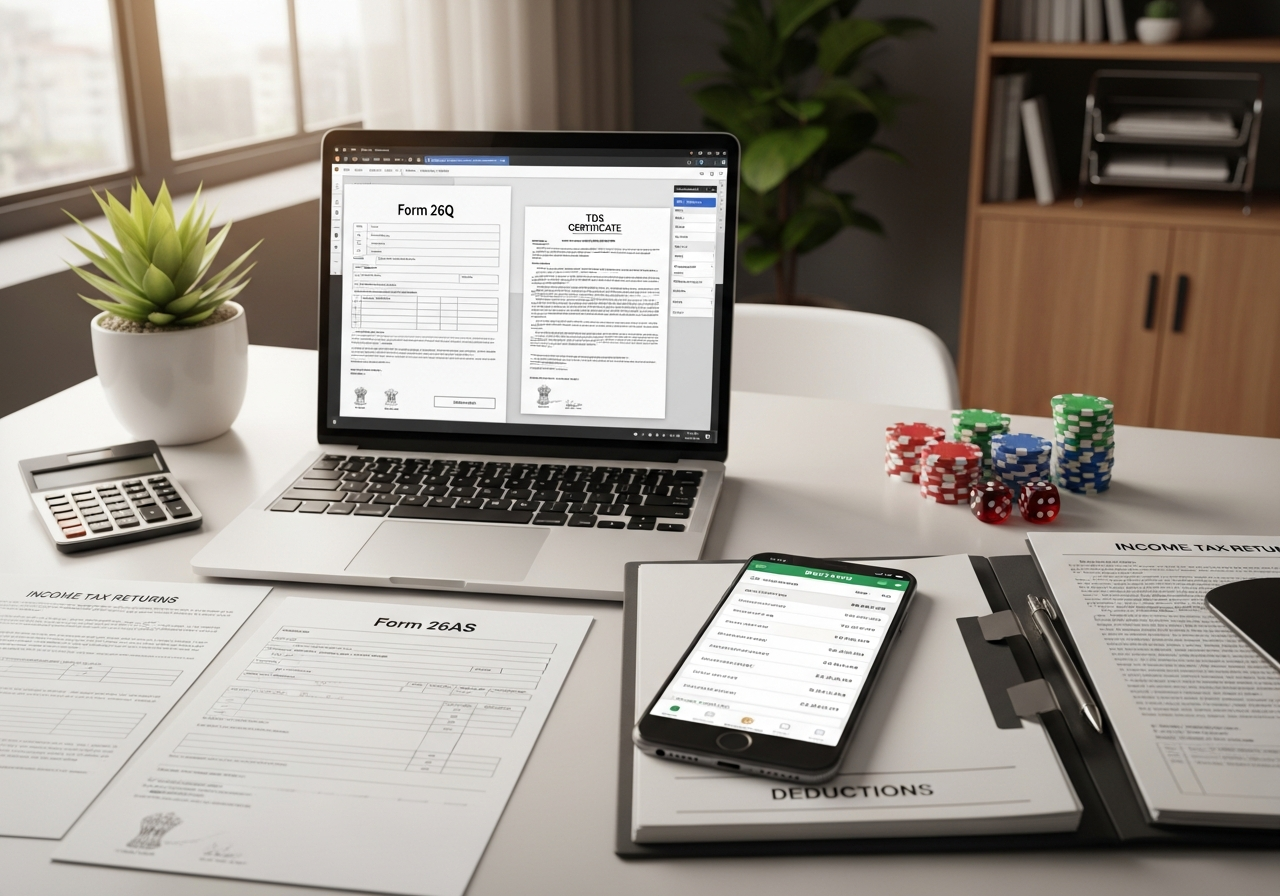
Indian betting and online gaming now operate under one of the world’s strictest tax regimes. Since the introduction of section 194BA and the expansion of TDS rules, a flat 30% tax deduction on winnings has become standard across most platforms. Yet few bettors understand the backbone of this system: Form 26Q, the quarterly non-salary TDS return that platforms file with tax authorities to report every deduction they make on your behalf.
Form 26Q is not a form you will ever file personally. Instead, it is the document that bridges your winnings and the tax authorities’ records. When a platform deducts 30% TDS from your net winnings, that deduction is recorded in Form 26Q and later reflected in your Form 26AS or Annual Information Statement (AIS). This connection matters enormously. If Form 26Q is filed incorrectly or late, your TDS credit might not appear when you file your Income Tax Return (ITR). If your TDS credits are missing or mismatched, refund claims can be delayed, audit notices can emerge, and reconciliation can become a headache. Understanding how Form 26Q works helps you see the full picture: when TDS is deducted, how it flows through the tax system, and what risks arise if platforms handle it poorly. This guide translates the mechanics of Form 26Q into practical outcomes for Indian bettors and gamers.
Understanding Form 26Q in the Context of Betting and Gaming
Form 26Q is the quarterly statement of TDS deducted on non-salary payments. For bettors, it is the official record of winnings reported to the Income Tax Department and the TDS deducted by platforms, bookmakers, and racecourse managers. Platforms and betting operators are legally required to file Form 26Q every quarter to report TDS collected under sections 194B (traditional betting, lotteries, gambling), 194BB (horse race winnings), and 194BA (online gaming). While you never file this form yourself, the data platforms enter into Form 26Q determines what appears in your Form 26AS/AIS and directly shapes your tax compliance obligations and refund eligibility.
| Aspect | Form 26Q Requirement | Relevance to Indian Bettors |
|---|---|---|
| Purpose | Quarterly reporting of TDS deducted on non-salary payments | Creates official record of your winnings and TDS credit with tax authorities |
| Who Files | Deductors (platforms, bookmakers, racecourse operators) | Bettors never file; they rely on platform accuracy |
| Sections Covered | 194B, 194BB, 194BA, 115BBJ | Determines under which TDS section your winnings are classified and taxed |
| Timing | Quarterly due dates (15th of month after quarter-end) | Late filings delay TDS credit visibility in your Form 26AS |
| Data Trail | Includes PAN, winnings amount, TDS deducted, section code | Forms the basis for your ITR reconciliation and refund claims |
| Impact on Bettor | Shapes TDS credit available for ITR filing | Missing/incorrect entries create mismatches, audit risk, and refund delays |
Key Legal Provisions Connected to Form 26Q
Form 26Q links directly to four key tax sections that govern betting and gaming income in India. Section 194B applies a flat 30% TDS on winnings from lotteries, crossword puzzles, card games, gambling, and betting where the amount exceeds a threshold. Section 194BB covers horse race winnings specifically, with a 30% TDS rate and a ₹10,000 threshold. Section 194BA, introduced to regulate online gaming, imposes 30% TDS on net winnings without a threshold and applies to skill-based and chance-based games on digital platforms. Section 115BBJ is the special tax regime that applies to online gaming income: it imposes a flat 30% tax on net winnings regardless of the bettor’s overall income slab, and importantly, disallows all deductions and set-offs against this income.
When Form 26Q is filed, each TDS entry is tagged with one of these section codes. This classification is critical because it tells the tax system—and eventually your ITR—under which law your winnings are taxed and what rules apply to deductions and credits. Misclassification in Form 26Q can lead to incorrect tax treatment in your hands and potential scrutiny from authorities.
Role of Deductors vs Bettors
Platforms, bookmakers, and racecourse operators are deductors—they have statutory obligations to collect TDS, deposit it with the government, and file Form 26Q quarterly. Your role as a bettor (the deductee) is different: you must provide your PAN to the platform so TDS can be linked to your account, monitor the TDS deducted via your account statements and Form 16A (the TDS certificate issued by the platform), cross-check this information against Form 26AS/AIS when it becomes available, and report your winnings accurately in your ITR under ‘Income from Other Sources’ while claiming the TDS credit.
The deductor handles the mechanics; you handle the reconciliation and compliance. If a platform fails in its duty—by not deducting TDS, depositing it late, or filing Form 26Q incorrectly—you, the bettor, will suffer the consequences: missing TDS credits, audit notices, or refund delays. This is why understanding platform practices and Form 26Q mechanics is essential to protecting your interests.
TDS Rules on Betting, Gambling and Online Gaming Winnings
The 30% TDS regime applies across all forms of betting and gaming in India, but the details vary by category. Understanding these differences is crucial because they affect when TDS is deducted, what the tax base is, and how Form 26Q records it.
- Section 194B (Traditional Betting, Lotteries, and Gambling): TDS is deducted at 30% on winnings above a threshold (often ₹10,000 or the full amount depending on the nature of the game). TDS is typically deducted at the point of payment to the bettor. For example, if you win ₹50,000 from a lottery or card game, the platform deducts ₹15,000 (30%) as TDS and pays you ₹35,000 net. This deduction is reported in Form 26Q under section 194B.
- Section 194BA (Online Gaming): TDS is deducted at 30% on net winnings—that is, winnings minus entry fees or amounts staked. Critically, there is no ₹10,000 threshold; TDS applies even on small net wins. The deduction can occur at the time of withdrawal or at year-end, depending on the platform’s practice. This is the most commonly applied section for skill-based games (fantasy sports, online poker) and chance-based games (online slots, roulette) offered by Indian platforms. Form 26Q entries under 194BA will show the net winning amount and the corresponding 30% TDS.
- Section 194BB (Horse Race Winnings): TDS is deducted at 30% on horse race winnings above ₹10,000. The deduction occurs when winnings are claimed. Racecourse operators are the deductors, and they file Form 26Q to report such TDS.
- Section 115BBJ (Special Regime for Online Gaming): This is not a TDS section but a special tax rule applied to online gaming income. Under this section, online gaming winnings are taxed at a flat 30% rate in the bettor’s hands, regardless of the bettor’s overall income slab. Importantly, section 115BBJ disallows any deductions or set-offs against this income—meaning you cannot claim losses from other bets or games, professional expenses, or any other deduction. TDS collected under 194BA is credited against this 30% tax liability.
Horse Race and Offline Betting Winnings under Section 194BB
Horse race betting is treated separately under section 194BB. When you place a bet at a racecourse or through an authorized betting operator and win an amount exceeding ₹10,000, the operator deducts 30% TDS immediately upon payout. For instance, if you win ₹30,000 on a horse race, the operator deducts ₹9,000 (30%) and hands you ₹21,000. This TDS is deposited with the government and reported in Form 26Q under section 194BB with the bettor’s PAN.
The key difference from online gaming is the threshold: TDS applies only above ₹10,000. Winnings below ₹10,000 are paid in full without TDS. However, this does not mean winnings below ₹10,000 are tax-free. They must still be disclosed in your ITR under ‘Income from Other Sources,’ and you pay tax at your applicable slab rate on the full amount. The ₹10,000 threshold is merely a trigger for TDS deduction, not an exemption.
How Form 26Q Operationally Controls TDS for Indian Bettors
The journey of your TDS begins with the bet, continues through deduction, and ends in Form 26Q—a document that bridges your platform account and the tax system. Here is how the operational flow works and what each step means for you as a bettor.
| Step | Deductor Obligation | Impact on Bettor |
|---|---|---|
| Bet Placed & Won | Platform records win in system; identifies applicable TDS section (194B, 194BA, 194BB) | Your win is documented internally; TDS calculation begins |
| Net Winnings Calculated | Platform computes net amount (winnings minus entry fees for 194BA; gross amount for 194B/194BB) | The tax base for your 30% TDS is determined |
| TDS Deducted | 30% TDS deducted from your winning amount at withdrawal or year-end | You receive reduced payout; TDS amount is identified |
| TDS Deposited | Platform deposits TDS with government via challan within prescribed deadlines | Government receives your TDS; deadline misses incur interest/penalties on platform |
| Form 26Q Filed Quarterly | Platform files Form 26Q with tax authority, listing your PAN, winnings, TDS deducted, and section code | Your TDS record enters the tax system; becomes visible to authorities and eventually to you |
| Form 16A Issued | Platform provides TDS certificate (Form 16A) to you, detailing TDS deducted in that quarter | You get documentary proof of TDS linked to your PAN |
| TDS Reflected in Form 26AS | Within weeks/months after Form 26Q filing, TDS appears in your Form 26AS under the relevant section | Your TDS credit becomes visible; you can download it from the IT portal |
| ITR Filed by Bettor | You download Form 26AS, note your TDS credit, report winnings in ITR, and claim credit | Correct reporting ensures refund eligibility and avoids mismatches/notices |
The accuracy and timeliness of Form 26Q directly determine whether your TDS credit appears in Form 26AS on time. Delays in platform Form 26Q filing mean delayed visibility of your TDS, which can hold up refund processing. Errors in Form 26Q—such as wrong PAN, wrong section code, or incorrect amounts—can cause mismatches when you file your ITR, triggering notices or denials of credit.
Quarterly Due Dates and Reporting Cycles
Form 26Q must be filed quarterly by platforms and betting operators. The due dates are strictly enforced:
- Q1 (April–June): Due by 15 July
- Q2 (July–September): Due by 15 October
- Q3 (October–December): Due by 15 January (next year)
- Q4 (January–March): Due by 15 April
Late filing of Form 26Q triggers interest and penalties on the deductor (platform), but the indirect cost to you is real. If your platform files Form 26Q late in Q1, your TDS credit might not appear in Form 26AS until late September or even October. If you file your ITR in July expecting to claim this TDS and it is not yet visible, you face two options: file without the credit and amend later, or delay your ITR filing until Form 26AS is updated. Both create friction and risk.
Understanding these cycles helps you anticipate when to expect Form 16A and when to check Form 26AS before filing your ITR. If a quarter is coming to a close and you have significant winnings, it is worth noting the Form 26Q due date for that quarter so you can follow up with your platform if TDS credit does not appear within a reasonable time after the deadline.
Sections and Codes Used for Betting Winnings in Form 26Q
When a platform files Form 26Q, each TDS entry includes a section code: 194B, 194BA, 194BB, or others. This code is critical because it tells the tax system how to treat the income in your ITR. If a platform incorrectly codes a ₹50,000 online gaming win as 194B instead of 194BA, the tax authority’s system may misclassify the income, and when you file your ITR with the correct section, a mismatch arises.
The section code also affects what rate and regime apply. For 194BA entries (online gaming), the special regime under section 115BBJ applies: a flat 30% tax with no deductions allowed. For 194B entries (traditional gambling), the income falls under ‘Income from Other Sources’ in your ITR, where deductions may be allowed in some cases (though courts have often disallowed them). For 194BB entries (horse race winnings), similar treatment to 194B applies.
Bettors should request clarity from their platform on which sections apply to their winnings. Reputable platforms disclose this in their tax documents or Form 16A. If a platform cannot or will not explain section codes, it is a red flag for compliance quality.
Net Winnings vs Gross Winnings: How Your Tax Base Is Calculated
One of the most significant differences in the Indian betting tax regime is how the tax base is computed for different games. This directly affects the amount of TDS you pay and how Form 26Q reports your income.
| Type of Game | Tax Base Definition | TDS Treatment | Reported in Form 26Q Under |
|---|---|---|---|
| Online Gaming (Skill/Chance) | Net winnings = Winnings minus entry fees/staked amounts | 30% TDS on net winnings; no ₹10,000 threshold; deduction at withdrawal or year-end | Section 194BA |
| Lottery / Crossword / Traditional Gambling | Gross winnings (full amount won) | 30% TDS on gross winnings; ₹10,000 threshold in many cases | Section 194B |
| Horse Race Betting | Gross winnings (full amount won) | 30% TDS on gross winnings; ₹10,000 threshold | Section 194BB |
| Offline Card Games / Casual Betting | Gross winnings (context-dependent) | 30% TDS on gross winnings; threshold varies | Section 194B or context-specific |
The Net Winnings Concept for Online Gaming: Under section 194BA, if you enter a fantasy cricket league with an entry fee of ₹500, and your team wins prize money of ₹5,000, your net winning is ₹4,500 (₹5,000 minus ₹500). TDS at 30% is calculated on ₹4,500, which equals ₹1,350. You receive ₹3,150 net. This approach is fairer than taxing the full ₹5,000 because it acknowledges that you spent ₹500 to earn the ₹5,000.
Contrast with Traditional Gambling: If you win ₹5,000 from a lottery, the full ₹5,000 is the tax base. TDS at 30% is ₹1,500, and you receive ₹3,500. The entry fee for a lottery ticket may be ₹100, but it is not deducted from the tax base. This is why online gaming TDS, while still 30%, can feel more tolerable on a net basis.
Form 26Q must clearly distinguish between net and gross amounts. If a platform incorrectly reports net winnings as gross (or vice versa), the TDS amount in Form 26Q will be wrong, leading to mismatches in Form 26AS and ITR.
Impact of Net Winnings Calculations on Bettors’ Cash Flows
For high-volume bettors, the net winnings calculation and 30% TDS have a compounding effect on bankroll. Suppose you are a fantasy sports enthusiast with a ₹100,000 bankroll. You enter 10 contests over a month, each with a ₹5,000 entry fee (₹50,000 total). Your net winnings across all contests are ₹30,000. TDS at 30% is ₹9,000, leaving you ₹21,000 to withdraw or reinvest.
Your effective bankroll after the month is ₹100,000 – ₹50,000 (entry fees) + ₹21,000 (net winnings after TDS) = ₹71,000. You have made ₹30,000 in net winnings but only netted ₹21,000 after tax. This 30% leakage is permanent. Over many betting cycles, this compounds.
Understanding this mechanics helps you plan withdrawals strategically. Rather than withdrawing immediately after each win (which triggers TDS on that withdrawal), some platforms allow you to keep winnings in your account for subsequent entries. If your next contest yields a loss, you offset the loss against the previous win, reducing the net winning amount subject to TDS. However, this strategy requires careful tracking and depends on platform mechanics.
Additionally, if you have a bad month and end with a net loss across all contests (entry fees exceed winnings), no TDS is deducted, but you still cannot claim this loss against other income in your ITR due to section 115BBJ. This asymmetry—tax on gains, no relief on losses—is another reason to manage bankroll and withdrawal timing carefully.
Penalties, Interest and Compliance Risks Linked to Form 26Q
While platforms bear the direct penalties for Form 26Q violations, bettors face indirect but serious consequences. Late or incorrect Form 26Q filings create friction that impacts your tax position.
- Late Form 26Q Filing: If a platform files Form 26Q after the due date, the platform is liable for interest at 1% per month (or part thereof) on the TDS amount. More importantly for you, delayed filing means your TDS credit does not appear in Form 26AS on time. If you file your ITR before the TDS is recorded, you cannot claim the credit until a subsequent amended return—extra work and risk of mismatch notices.
- Non-Deduction of TDS: If a platform fails to deduct TDS on winnings, it is liable for interest and penalties. For you, this means you receive the full winning amount, but the platform’s Form 26Q entry may show zero TDS or a partial amount. You are now obligated to self-assess and pay the 30% tax (or applicable rate) when filing your ITR. This can create cash flow issues if you have already spent the winnings.
- Incorrect TDS Amount in Form 26Q: If Form 26Q shows TDS less than or more than what you actually paid, Form 26AS will reflect the incorrect amount. When you file your ITR, you must reconcile your actual TDS (shown in your Form 16A or platform statement) with what appears in Form 26AS. Mismatches trigger scrutiny.
- Mismatch Between AIS and ITR: The most common risk for bettors is that Form 26AS (via AIS) shows winnings or TDS amounts that differ from what you report in your ITR. This mismatch is flagged by the tax system and can lead to a notice under section 143(1) or further scrutiny. High-volume bettors or those with multiple platforms are especially at risk because aggregating data across platforms is complex.
Nil and Low-TDS Returns: When Platforms Still File Form 26Q
Some platforms may file Form 26Q with “nil” or very low TDS entries. This can happen if:
- The platform did not deduct TDS on certain winning amounts (e.g., promotional bonuses, free plays, or specific game types deemed non-taxable by the platform).
- The platform calculated net winnings as zero or negative (losses).
- The platform deferred TDS to year-end and filed quarterly nil returns until the final quarter.
A nil Form 26Q entry is not inherently problematic. It may simply indicate no TDS deduction in that quarter. However, if you know you won substantial amounts and the Form 26Q shows nil TDS, it signals either a platform error or that the platform did not consider those winnings taxable. This discrepancy must be investigated. Request your platform’s tax statement and Form 16A to verify. If the platform cannot explain the nil TDS, escalate the matter because you may be at risk of an incomplete tax trail.
Practical Risk Scenarios for Indian Bettors
Scenario 1: Offshore Platform with No TDS Trail
You use an offshore betting site that does not comply with Indian TDS rules. The site has no PAN collection mechanism and does not file Form 26Q. You win ₹200,000 and withdraw it via crypto or international wire. Your Form 26AS shows zero TDS from this site. When you file your ITR, you disclose the ₹200,000 as income from ‘Other Sources’ but show zero TDS. The tax authority’s system flags this as an unusual large income with no TDS trail. You face a notice asking for proof of source. If you cannot demonstrate that the platform is regulated (which it is not), you may face additional scrutiny, penalties, or demands for back-calculation of interest.
Scenario 2: Use of Multiple Indian Platforms without Centralized Tracking
You use three different licensed Indian betting apps over a year. Each deducts TDS and files Form 26Q separately. When Form 26AS is generated, it lists TDS from all three under different sections (one under 194B, two under 194BA). You file your ITR but accidentally report only two platforms, omitting the third. The tax authority notices the discrepancy between AIS and ITR and sends a notice. You must file an amended return, and depending on the amount, you may face a penalty.
Scenario 3: Promotional Bonuses and Unclear TDS Treatment
A platform credits you a ₹10,000 promotional bonus without requiring a deposit. You use it to win ₹50,000, bringing your balance to ₹60,000. The platform’s TDS logic is unclear: does it calculate TDS on ₹50,000 (gross winnings), ₹40,000 (net after the bonus is subtracted), or something else? The platform files Form 26Q showing TDS on ₹50,000, but you believe it should be less. Mismatch arises, and reconciliation becomes complex.
These scenarios underscore the importance of platforms filing Form 26Q correctly and bettors actively reconciling their records with Form 26AS before filing ITR.
How Bettors See Form 26Q Data in Form 26AS and AIS
Form 26Q, filed by platforms quarterly, eventually consolidates into Form 26AS, which is the Annual Information Statement available to you on the Income Tax portal. Form 26AS shows all TDS deducted on your PAN across all sources and all deductors (employers, financial institutions, betting platforms, etc.) during the financial year.
| Data Point | Source (Form 26Q Field) | Where Bettor Sees It | Usage in ITR |
|---|---|---|---|
| Bettor’s PAN | Line item in Form 26Q | Form 26AS / AIS header and detail rows | Ensures TDS is linked to correct PAN and ITR filer |
| Winnings Amount | “Gross Amount” or “Net Amount” field in Form 26Q | Form 26AS detail row under relevant section (194B, 194BA, 194BB) | Reconcile with your platform statement; disclose in ITR under ‘Income from Other Sources’ |
| TDS Deducted | “TDS Amount” field in Form 26Q | Form 26AS detail row; also shown in “TDS Credit” summary | Claim as credit against tax liability in ITR |
| Section Code | Section code (194B, 194BA, 194BB) in Form 26Q | Form 26AS shows this code; helps identify which TDS rule applied | Determine applicable tax regime (115BBJ for 194BA) and ensure correct ITR classification |
| Deductor Name & TAN | Deductor details in Form 26Q | Form 26AS shows platform/operator name and TAN | Verify that TDS is from correct platform; useful if you dispute an entry |
| Financial Year | Quarter end date in Form 26Q | Form 26AS is annual; Form 26Q quarterly data rolls into it | Ensure TDS is recorded in correct financial year for your ITR |
| Date of TDS Deposit | Challan deposit date (from platform’s bank records) | Not directly visible in Form 26AS, but can be verified via NSDL website | Useful for tracking delays; establishes whether TDS was deposited on time |
The Connection Between Form 26Q and Form 26AS: Platforms file Form 26Q with the tax authority every quarter. The tax authority then aggregates all Form 26Q entries by PAN and publishes them in Form 26AS, typically available online by September–October after the financial year-end. If a platform files Form 26Q late (e.g., in December instead of October), your TDS will not appear in Form 26AS until months later.
What Happens If Form 26Q Is Missing or Incorrect: If a platform fails to file Form 26Q or files it with your wrong PAN, your TDS will not appear in Form 26AS at all. When you file your ITR and claim TDS credit based on your Form 16A (platform certificate) or your records, the credit does not match Form 26AS. The tax system flags this as a mismatch. You must then prove that you deserve the credit by submitting your Form 16A and platform statement. This process delays your refund and invites scrutiny.
Reconciling Winnings and TDS Credits Before Filing ITR
Before you file your ITR, always reconcile your betting winnings and TDS across all platforms with your Form 26AS. Here is a step-by-step checklist:
- Download Form 26AS: Log into the Income Tax e-portal (incometaxindiaefiling.gov.in) with your PAN and password. Navigate to “View Form 26AS” and download the annual statement for the relevant financial year. (Note: You may also receive Form 26AAS for advance summaries; start with the full Form 26AS.)
- Identify Betting-Related Entries: Look for entries under sections 194B, 194BA, or 194BB. These will list winnings amounts and corresponding TDS. Note the deductor name (platform name), TDS amount, and winnings amount for each entry.
- Gather Your Platform Statements: Download statements or tax summaries from each betting platform you used. These should show winnings, TDS deducted, and the section under which TDS was deducted.
- Match Platform Data with Form 26AS: For each platform, verify that the winnings amount and TDS amount in Form 26AS match your platform statement. Check deductor names and TANs to ensure they are correct. If amounts differ, note the discrepancy.
- Identify Missing Entries: If you know you had winnings from a platform but no entry appears in Form 26AS, contact the platform immediately. Request a copy of the Form 26Q they filed and ask why your PAN is not included. Request they file a correction if necessary.
- Total TDS Available for Credit: Sum all TDS amounts from Form 26AS entries under 194B, 194BA, and 194BB. This is the total TDS credit you can claim in your ITR.
- Calculate Your Total Winnings and Reconcile with ITR: Sum all winnings amounts from Form 26AS (and add any winnings not yet recorded in Form 26AS, if you have evidence). Ensure this total matches or is consistent with what you are about to report in your ITR. Discrepancies must be explained.
- File Your ITR with Matching Data: Report winnings in your ITR under ‘Income from Other Sources’ (typically Schedule 128 in the new ITR form). Claim the total TDS credit calculated above. If there are discrepancies with Form 26AS, file your ITR with the correct amounts and prepare documentation (Form 16A, platform statements) to substantiate your position in case of a notice.
By reconciling before filing, you avoid surprises post-filing and reduce the risk of mismatches that invite notices.
Tax Treatment of Betting Winnings in the Bettor’s ITR
Once you have confirmed your winnings and TDS via Form 26AS, you must report them correctly in your ITR. The treatment depends on the type of game and applicable tax regime.
- Report All Winnings Under ‘Income from Other Sources’: Regardless of the amount or frequency, all betting, gaming, gambling, and horse race winnings must be disclosed in your ITR under the head ‘Income from Other Sources.’ This includes casual wins and regular wins; the income source matters, not the frequency.
- Classify by Section: If you have winnings from multiple sources (e.g., online gaming, horse races, lotteries), group them by section (194B, 194BA, 194BB) in your ITR. The new ITR forms ask for section-wise details, especially for 194BA entries which fall under section 115BBJ.
- Apply Section 115BBJ to Online Gaming: If you have online gaming winnings under section 194BA, these fall under the special regime of section 115BBJ. Under this section, tax is calculated at a flat 30% rate on the net winnings (winnings minus entry fees), regardless of your overall income slab. Importantly, no deductions are allowed against this income. Even if you have losses from other bets or professional expenses, you cannot set them off against online gaming winnings. TDS already deducted at the platform is credited against this 30% tax.
- For Traditional Gambling and Horse Race Winnings (194B and 194BB): These are taxed as regular ‘Other Sources’ income in your income slab. For instance, if you are in the 20% tax bracket and win ₹100,000 from a lottery, your tax liability on this ₹100,000 is ₹20,000. TDS of ₹30,000 (30% of ₹100,000) is already deducted and credited. You can claim a refund of ₹10,000 (₹30,000 TDS minus ₹20,000 tax due). However, some court rulings have disallowed deductions against these sources of income, making tax treatment nuanced.
- Deductions Are Generally Not Allowed: Against betting and gaming income, deductions are severely restricted. You cannot claim professional fees, travel expenses, losses from other games, or other costs as deductions against betting winnings. The income is taxed on a gross basis in most cases.
Claiming TDS Credits and Potential Refunds
Your TDS credit is the amount deducted by platforms and reported in Form 26Q (visible in Form 26AS). When you file your ITR, you claim this credit against your total tax liability. If the TDS credit exceeds your tax liability, you are entitled to a refund.
Example: You have online gaming winnings of ₹100,000. TDS at 30% is ₹30,000. Your tax liability under section 115BBJ is ₹100,000 × 30% = ₹30,000. TDS of ₹30,000 is credited against this ₹30,000 liability. Net tax payable is zero, and no refund is due. You have neither paid additional tax nor received a refund.
Example 2: You have horse race winnings of ₹100,000 and are in the 20% tax bracket. Your tax liability under section 194BB is ₹100,000 × 20% = ₹20,000. TDS deducted is ₹30,000 (30% of ₹100,000). You claim the ₹30,000 TDS credit. Net tax payable is ₹20,000 – ₹30,000 = -₹10,000, meaning you are due a refund of ₹10,000. You file your ITR and claim the refund.
To claim TDS credit correctly:
- In your ITR (Schedule 128 or relevant section), report the TDS amount corresponding to each section.
- Ensure the amount matches Form 26AS.
- Request the refund in your ITR if TDS exceeds liability.
- The tax authority processes refunds within 90 days typically, though delays are common.
If you have not filed your ITR, you cannot claim the TDS credit, and it lapses after a few years (usually 7 years from the end of the relevant financial year).
Effect of Non-Filing or Late Filing of Bettor’s ITR
If you do not file your ITR despite having betting income and TDS deducted, the TDS remains unutilized. More critically, you are in violation of section 139(1) of the Income Tax Act, which requires filing if you have income above the basic exemption limit. Penalties for non-filing include:
- Penalty under section 271F: ₹5,000 if ITR not filed (for non-corporate assessees).
- Loss of Refund: Any refund due (if TDS exceeds liability) lapses. The government effectively retains your refund as an interest-free loan.
- Statutory Compliance Risk: Without an ITR, you are technically in violation. This can affect loans, visas, or other formal applications requiring tax compliance.
If you file your ITR late but within the year, there is no penalty, but any refund due is delayed. Filing late also increases the window for the tax authority to issue a notice if there are discrepancies with Form 26AS.
For bettors, timely ITR filing is essential to claim TDS credit and secure refunds. It is also the safest way to demonstrate voluntary compliance and good faith to tax authorities.
Strategic Tips for Indian Bettors to Manage TDS Friction
The 30% TDS regime is here to stay, but you can manage its impact on your bankroll and tax compliance through deliberate strategies.
- Always Share Your PAN with Platforms: This is non-negotiable. If a platform does not ask for your PAN, it is either unregulated or deliberately avoiding TDS reporting. Do not use such platforms. Providing your PAN ensures TDS is linked to your account and reflected in Form 26AS, which is essential for ITR reconciliation.
- Prefer Licensed Indian Operators: Use platforms that are regulated, file Form 26Q, issue Form 16A, and have published tax policies. These platforms may impose the 30% TDS friction, but they ensure a clean tax trail that protects you.
- Track Net Winnings Meticulously: For online gaming platforms, maintain a running record of entry fees paid and winnings received. Understand how the platform calculates net winnings for TDS purposes. If the platform’s calculation differs from your understanding, escalate before withdrawing.
- Plan Withdrawals Around TDS and Liquidity Needs: Rather than withdrawing immediately after each win, some platforms allow you to keep winnings in your account for subsequent plays. If your next contest is likely to lose, you reduce the net winning amount subject to TDS. However, this requires confidence in your edge and disciplined bankroll management.
- Download and Cross-Check Form 26AS Quarterly: Do not wait until ITR filing season to reconcile with Form 26AS. Check it quarterly (after Form 26Q deadlines) to ensure your winnings and TDS are being recorded correctly. If discrepancies exist, follow up with platforms immediately.
- Maintain Comprehensive Records: Keep all platform statements, Form 16A certificates, and withdrawal confirmations. These documents are your defense if the tax authority questions your ITR. Organized records also simplify your own reconciliation work.
- Avoid Off-the-Books or Unregulated Platforms: Winnings from unregulated or offshore sites have no TDS trail. If you win significant amounts from such sources, you are entirely dependent on self-assessment and voluntary disclosure when filing ITR. This is risky because any discrepancy in your ITR is harder to substantiate without a Form 26Q trail.
Bankroll and Withdrawal Planning Under the New 30% Regime
The 30% TDS directly impacts your effective bankroll. If you have a ₹500,000 bankroll and earn ₹100,000 in net winnings, you owe ₹30,000 in TDS, leaving ₹70,000 net. Your effective return is 14% (₹70,000 / ₹500,000) after TDS, not 20%.
Plan your bankroll assuming a 30% TDS leakage on net winnings. If you need liquidity, calculate withdrawals factoring in the TDS hit. For example, if you need ₹30,000 net cash, and you have won ₹50,000, you will owe ₹15,000 in TDS, leaving ₹35,000—enough to meet your ₹30,000 liquidity need with a small buffer.
Additionally, if you are a high-frequency bettor with multiple contests per week, your net winnings accumulate quickly, and so does the TDS liability. Track cumulative TDS monthly so you are not surprised when filing your ITR. Some high-volume bettors set aside 30–35% of gross winnings into a tax reserve account to cover the TDS hit and potential tax liability.
Timing withdrawals also matters from a liquidity perspective. If a platform defers TDS to year-end, your withdrawals mid-year are paid in full (with TDS calculated and deducted at year-end). This can improve cash flow during the year, though you will owe TDS eventually. Understand your platform’s TDS timing and plan accordingly.
Platform Compliance Checklist: What Serious Bettors Should Look For
Before you commit to a platform, evaluate its tax compliance infrastructure. A platform’s quality on these indicators determines whether your tax trail will be clean or problematic.
| Compliance Indicator | What the Platform Should Do | Signal for Bettors |
|---|---|---|
| PAN Collection | Collect PAN during registration or KYC; mandatory for all users | If platform does not ask for PAN or makes it optional, avoid it; indicates non-compliance |
| TAN Availability | Provide their Tax Account Number (TAN) in tax documents and policies | Platform with a valid TAN is regulated; verify it on NSDL website; platforms without a TAN are red flags |
| Form 26Q Filing | File Form 26Q quarterly within due dates (15th of month after quarter-end) | Request proof of filing from platform; delays indicate poor tax management |
| Form 16A Issuance | Issue Form 16A (TDS certificate) every quarter or annually; include PAN, TDS amounts, section code | Download Form 16A from your account; it should match your records and Form 26AS later; missing Form 16A is a major red flag |
| TDS Deduction Timing | Deduct TDS at withdrawal or year-end consistently; clearly communicate timing to users | Understand when TDS is deducted for your cash flow planning; inconsistent timing suggests process issues |
| Tax Disclosure | Provide clear, written disclosure of TDS rules, sections applicable, and tax treatment of different game types | Download and review the platform’s tax policy; vague or missing disclosures indicate low compliance maturity |
| KYC/Documentation | Collect KYC documents (ID, address, PAN) and maintain records; share TDS details via email or account portal | Full KYC creates trust and ensures your PAN is correctly recorded; incomplete KYC is risky |
| Customer Support for Tax Queries | Respond to questions about TDS calculations, Form 16A, and tax treatment; provide written clarifications | Contact support with a tax query and evaluate responsiveness; poor support on tax matters is a red flag |
| NSDL/TDS Portal Verification | File Form 26Q with NSDL; you can verify filing via NSDL TDS portal with platform’s TAN and quarter | If possible, verify that Form 26Q is actually filed; not all platforms are transparent, but willing operators allow verification |
Red Flags: When Platform TDS Practices May Hurt You
- No PAN Collection: Platform does not ask for or collect your PAN. TDS deducted by such platforms cannot be linked to you, making it worthless. You have no tax trail.
- Vague or Missing Tax Statements: Platform provides no Form 16A, no clear tax policy, or cannot explain which section (194B, 194BA, 194BB) applies to your winnings. You have no documentary evidence of TDS.
- Guidance to Ignore or Avoid Tax: Platform advises you to use offshore accounts, crypto, or unregulated channels to avoid TDS. This is illegal and implicates you in tax evasion.
- Inconsistent TDS Calculations: TDS amounts vary unexpectedly across withdrawals, or platform cannot explain the calculation. Suggests internal process issues or deliberate misreporting.
- No Form 16A Despite Requesting: You ask for Form 16A, and the platform refuses, delays indefinitely, or provides a blank/generic document. Indicates the platform has not filed Form 26Q with your PAN.
- Pressure to Disclose Winnings as “Losses”: Platform suggests you report net losses on your ITR to avoid tax. This is fraud and can expose you to serious penalties.
- Absence of a TAN or Unverifiable TAN: Platform claims to have a TAN but cannot provide it, or the TAN does not appear in NSDL records. Suggests the platform is unregistered.
Comparing Indian-Regulated vs Offshore Platforms
Indian-Regulated Platforms: Licensed operators operating under Indian law (e.g., Fantasy Sports Regulation Model) collect PAN, file Form 26Q, issue Form 16A, and are subject to TDS rules. Using these platforms means:
- Clean TDS trail via Form 26Q → Form 26AS.
- TDS credit available for your ITR and refund claims.
- Full legal protection; disputes can be escalated to regulatory bodies.
- Compliance with tax law; lower risk of notices or penalties.
- Slightly higher costs due to TDS impact, but this is the price of legal operation.
Offshore Platforms: Betting sites operated from outside India, not licensed by Indian authorities. Using offshore platforms means:
- No Form 26Q filing; no TDS trail.
- TDS credit not available; you must self-assess and pay tax from your own pocket.
- No legal recourse if disputes arise; funds can be frozen or seized.
- Using offshore sites to circumvent Indian TDS rules is not illegal per se, but winnings are still taxable in India. Non-reporting or misreporting winnings from offshore sources can trigger notices, interest, and penalties if discovered.
- Higher risk of tax authority scrutiny, especially if your ITR shows unexplained large cash inflows.
- Recovery risk: If the offshore platform is subject to international sanctions or shutdowns, your funds may be lost permanently.
For serious bettors, Indian-regulated platforms, despite the TDS friction, offer the safest long-term path: clean tax records, refund eligibility, and legal certainty.
Future Trends: Regulatory Tightening Around Betting and Form 26Q
The Indian government and tax authorities are paying increasing attention to online gaming and betting income. Several trends suggest tightening regulation in coming years.
Enhanced Reporting Requirements: The Central Board of Direct Taxes (CBDT) has issued guidance to strengthen Form 26Q reporting for online gaming (section 194BA). Future updates may mandate more granular reporting—for example, separating skill-based and chance-based games, reporting player lifetime value, or flagging high-risk bettors. Platforms will need to invest in backend systems to meet these requirements, and bettors will have more detailed tax records.
Real-Time TDS Reporting: Currently, Form 26Q is filed quarterly. There are discussions about moving to real-time or monthly reporting via electronic systems. This would accelerate the visibility of TDS credits in Form 26AS, reducing friction for bettors, but also making the TDS trail more transparent to authorities.
Integration with Other Data Sources: Tax authorities increasingly cross-reference data from multiple sources. Form 26Q data from betting platforms will be matched with bank transaction records, cryptocurrency exchanges, and other financial institutions. This reduces the ability to hide income and increases detection of unreported winnings from unregulated sources.
Stricter Penalties for Non-Compliance: As the betting ecosystem matures, penalties for platforms failing to file Form 26Q or for bettors failing to report winnings are likely to increase. There may also be a shift toward stricter characterization of certain games (e.g., some “skill-based” games reclassified as chance-based and subject to different TDS rules).
Possible Expansion of TDS Scope: Currently, section 194BA applies to online gaming winnings. There are discussions about expanding the definition of “online gaming” to cover more esoteric digital games or wagering formats. Additionally, there is potential pressure to include sports betting under an expanded 194BA regime, which is currently not universally covered.
How Data from Form 26Q May Be Used by Tax Authorities
Form 26Q data, once aggregated at the CBDT level, provides tax authorities a comprehensive picture of betting activity in India. Authorities can identify:
- High-Risk Bettors: Individuals with large, frequent betting winnings relative to their reported income or profession. A software engineer reporting ₹50,000 salary but ₹500,000 in annual betting winnings would stand out as a high-risk case.
- Unreported Income Patterns: Comparing Form 26Q data with ITR filings, authorities can identify bettors who received TDS (recorded in Form 26Q) but did not report the corresponding income in their ITR. This mismatch is a red flag for deliberate underreporting.
- Unregulated Activity: Bettors with large unrecorded income (inferred from bank deposits or spending) but no corresponding Form 26Q entries are flagged as potential users of unregulated platforms, prompting inquiries.
- Patterns of Loss/Gain Manipulation: Bettors who report large losses on their ITR but show significant winning activity in Form 26Q data can be cross-checked for consistency.
- Tax Evasion Indicators: Combinations of high betting income, low ITR reporting, and high cash expenditure are typical tax evasion signatures. Form 26Q data helps authorities identify and investigate such cases.
The increasing use of Form 26Q data underscores the importance of truthful ITR reporting for bettors. Attempting to hide or minimize betting income while Form 26Q shows large TDS deductions is a mismatch that will be detected. Voluntary compliance—reporting winnings accurately and claiming TDS credit—is the safest strategy.
—
In conclusion, Form 26Q is the backbone of the Indian betting tax system. It transforms your platform winnings into an official tax record that shapes your ITR, refund eligibility, and compliance risk. Understanding Form 26Q mechanics—how winnings are classified, when TDS is deducted, how data flows to Form 26AS, and what reconciliation looks like—empowers you to manage your tax position proactively. By choosing compliant platforms, tracking your winnings, reconciling with Form 26AS before filing your ITR, and reporting truthfully, you align yourself with the law, secure your TDS credits, and minimize the risk of notices or penalties. The 30% TDS friction is real, but it is manageable with planning, discipline, and transparency.